
Every year, in the imperial city of Cusco, something happens that stops time. The cobblestone streets of the historic center fill with flower petals, incense, and the echo of marching bands accompanying fifteen saints and virgins in one of the most fascinating celebrations of the Andean world: Corpus Christi in Cusco.
Declared a National Cultural Heritage, this festival is far more than a religious procession. It's a living fusion between colonial Catholic faith and the Andean spirituality the Incas practiced centuries before the conquest. Here, past and present embrace in a single instant.
The Origins: Andean Faith and Catholic Devotion
To understand Cusco's Corpus Christi, we have to go back to the 16th century, when Spanish evangelizers found an Inca practice that seemed strangely familiar: the worship of the mummified bodies of Inca kings, the "mallquis," which were carried in procession during the great festivals of the Tahuantinsuyo.
Franciscan and Dominican friars used this parallel to graft the feast of Corpus Christi — which celebrates the presence of Jesus Christ in the Eucharist — onto existing calendars and rituals. The result was a syncretism unique in the world: a celebration in which Catholic saints took the place of Andean deities, and the faithful responded with the same devotion they once offered their ancestors.
That is how Cusco's Corpus Christi was born: a celebration that didn't erase Inca memory, but transformed it.
"Cusco's Corpus Christi didn't erase Inca memory — it transformed it into a celebration that joins two worlds into a single heartbeat."
The Procession of the Fifteen Saints
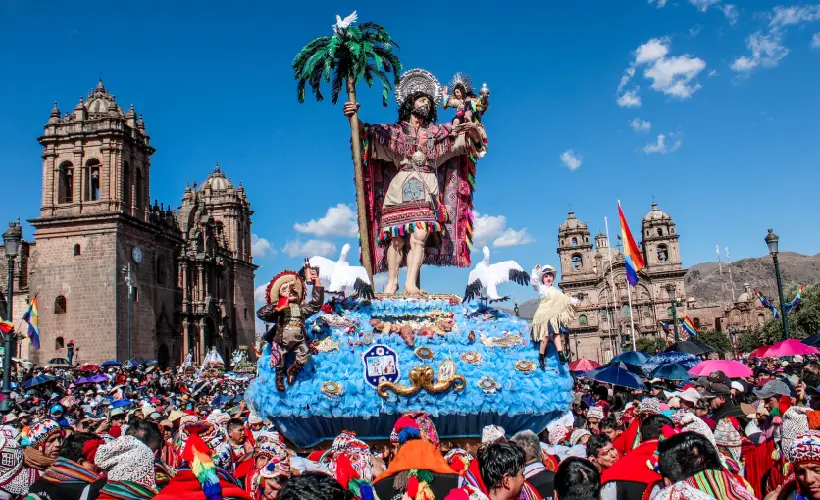
On the central day of the festival — usually in June, sixty days after Easter — fifteen saints and virgins from different parishes across Cusco are carried in procession to the Plaza Mayor, better known as the Plaza de Armas. Each image travels atop an elaborately decorated float, carried by hundreds of devotees known as "cargadores."
The floats are true works of art in motion: covered in silver and gold, adorned with flowers and mirrors, lit by candles flickering under the Andean sun. Cusco artisans spend months creating these portable altars, which rival the most beautiful processions in the world in their beauty.
During the afternoon and evening of Corpus, the saints "live together" inside Cusco Cathedral, and devout families gather around them to pray, sing, and share in the celebration.
San Cristóbal: The Giant Protector of Cusco
Among all the saints who take part in Cusco's Corpus Christi, San Cristóbal holds a very special place. Patron of the neighborhood that bears his name — one of the oldest in Cusco, located on the slopes of Sacsayhuamán hill — San Cristóbal is venerated as the protector of travelers and of the city itself.
His imposing image, depicting a giant carrying the child Jesus on his shoulders while crossing a river, embodies the spirit of protection and guidance that the people of Cusco feel toward their patron. Tradition holds that San Cristóbal protects all those who set out on a path, whether a physical journey or a spiritual one.
The San Cristóbal neighborhood still preserves its 16th-century colonial church today, built atop the remains of the palace of Collasuyo Roca, a former Inca noble. From its atrium, you get one of the most beautiful views of Cusco's colonial rooftops and the slopes of Sacsayhuamán.
"San Cristóbal, the giant protector, embodies the soul of a Cusco that never forgets where it comes from, nor where it's headed."
The Flavor of the Festival: Chiriuchu
Cusco's Corpus Christi can't be understood without its food. During these days, the Plaza de Armas and surrounding streets transform into a huge food market, where the star dish is chiriuchu: a cold preparation combining llama or alpaca jerky, roasted cuy, cured pork, sausage, corn tortilla, cheese, quail eggs, and seaweed from Lake Titicaca.
The name chiriuchu comes from Quechua: "chiri" (cold) and "uchu" (spicy), and its preparation varies from family to family. Eating a plate of chiriuchu in front of Cusco Cathedral, as the bands play and the devotees pass by, is a culinary and cultural experience that's hard to forget.
Chicha de jora — the sacred drink of the Incas — and roast suckling pig, prepared by families using recipes passed down through generations, are also abundant during the festival.
Tips for your visit
- Corpus Christi is celebrated 60 days after Easter Sunday; in 2026 it falls on June 4th.
- Arrive early at the Plaza de Armas (from 8:00 a.m.) to get a good spot in front of the cathedral.
- Try chiriuchu at the market stalls set up in the plaza — it's the ritual dish of Corpus.
- Wear warm clothing and bring a raincoat: June in Cusco can be cold, with the occasional downpour.
- Visit the San Cristóbal neighborhood the day before to see the preparations and the church decorations.
- Hire a local guide to understand the deeper meaning behind each saint and their history.
Cusco's Corpus Christi is, without a doubt, one of the most profound experiences Peru can offer a curious traveler. It's not just a procession: it's the living history of a people who transformed conquest into creation, who found in faith a common language between two worlds. Watching San Cristóbal and the other fourteen saints parade through Cusco's streets, amid the smoke of incense and the sound of the bands, is a reminder that culture doesn't die — it reinvents itself.